Monthly Archives: October, 2020

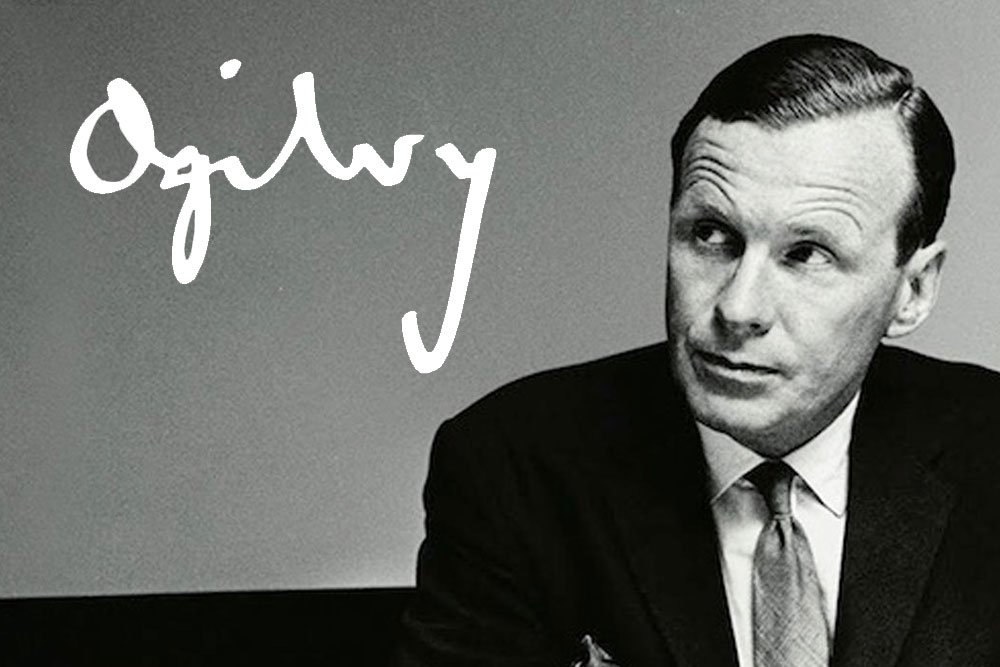
How to Make TV Commercials that Sell: 16 Tips from David Ogilvy

October 2, 2020 Posted by Marketing Advice 0 thoughts on “How to Make TV Commercials that Sell: 16 Tips from David Ogilvy”

I used to see commercials and wonder, “What are they trying to sell me?” Or remember a funny scene from a commercial and ask, “”What company was that?”
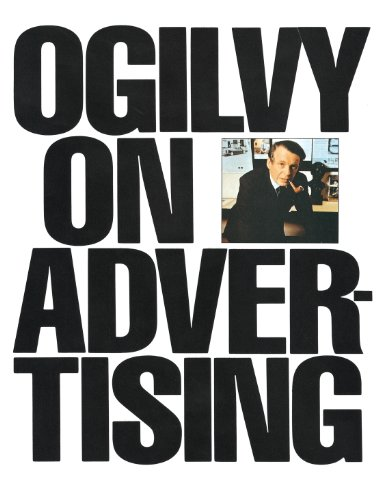
As a copywriting intern at Copper Sun Creative, I have been studying the strategies behind making effective TV commercials. I have been reading books by the advertising greats, including My Life in Advertising and Scientific Advertising by Claude Hopkins, as well as Ogilvy on Advertising by David Ogilvy. Both Ogilvy and Hopkins view advertising as a science and break down the strategies for how to effectively sell to consumers. 

I can now watch commercials and know what strategies a company neglected to use that made the commercial forgettable and why a funny scene was fitting for a comedy skit but not for remembering the brand name. Or notice the techniques used that made a commercial effective and categorize what type of commercial it is. 

Print this list and keep it handy

The list below of types of commercials and tips to create a commercial that sells is straight from David Ogilvy’s book Ogilvy on Advertising. Instead of trying to guess what was going through the minds of the advertisers, the next time you see a commercial that excites your interest in a product or a brand, print out this list and use it to analyze each and every aspect of the commercial. Keep it on your coffee table next to the stack of magazines or keep it in a google doc to bring up on your phone. 

10 types of commercials that change people’s brand preferences 

  1. Humor: Humor is acceptable in commercials..but “very few writers can write funny commercials which are funny. Unless you are one of the few, don’t try.”
  2. Slice of life: A semi-realistic scenario plays out where one person argues with another about the merits of a product and in the end, the doubter is converted. An example of this is Blue Buffalos’ dog food commercials
  3. Testimonials: The most effective are when a loyal customer is using a product and doesn’t know they are being filmed and someone comes up and questions the product and they defend it with conviction. An alternative form of an effective testimonial is the Pepsi challenge.
  4. Demonstrations: These show how well your product works. This works better if you don’t mention competing brands.
  5. Problem/solution: You show the viewer a familiar problem and show how your product can solve it. Snickers uses this in its You’re Not You When You’re Hungry commercials.
  6. Talking heads: A pitch person telling of the virtues of a product. This is used by Old Spice in its The Man Your Man Could Smell Like commercials.
  7. Characters: A character is used to sell a product over a number of years, but the character must be relevant to the product. They become a living symbol of the product. Smokey Bear comes to mind.
  8. Reasons why: Commercials give a reason why the customer should buy the product. 
  9. News: Old products can create news by advertising a new way to use it 

Example: Using baking soda to make your refrigerator smell sweet. 

  1. Emotion: Emotion can be just as effective as rational appeal especially when there is nothing unique to say about your product. You need to be able to justify emotional appeals.

16 tips for creating effective commercials 

  1. Brand identification: Ways to get viewers to remember your brand not just your commercial.
  1. Use the name within the first 10 seconds. 
  2. Play games with the name (example, spell it out).
  3. When you advertise a new product you have to teach people its name.
  1. Show the package 
  2. Food in motion: Example: Milk pouring into cereal 
  3. Close-ups: Good when the product is the hero of the commercial 
  4. Open with fire: You only have 30 seconds so grab their attention in the first frame. When you advertise fire-extinguishers, open with the fire. 
  5. When you have nothing to say, sing it: Jingles can be successful but not at changing brand preferences 
  6. Sound effects: Example: Sausages sizzling in a frying pan 
  7. Voice over or on-camera?: Research shows it is more effective to have actors on camera 
  8. Supers: it pays to reinforce your promise by setting it in type and superimposing it on your video 
  9. Avoid using banality: If you want the viewer to pay attention, show them something they’ve never seen before
  10. Changes of scene: Using a lot of short scenes is not profitable
  11. Mnemonics: (a visual device repeated over a long period of time) — It can increase brand identification and remind people of your promise
  12. Show the product in use
  13. Anything is possible on TV: CGI and special effects can make anything possible 
  14. Miscomprehension: many commercials are not understood, make them crystal clear 

The great scandal: Commercials are very expensive — art directors make them very expensive by not going for cheaper alternatives

About the author

Colin Young is a copywriter at Copper Sun Creative. He specializes in writing advertising and branding content. When he is not blogging or working to complete his bachelor’s degree in Marketing he enjoys doing anything outdoors.
The Smokey Bear Wildfire Prevention Campaign

October 2, 2020 Posted by History of Advertising 0 thoughts on “The Smokey Bear Wildfire Prevention Campaign”

In the weeks prior to the start of World War II, the Ad Council was formed. The Ad Council is an organization that brings together the advertising industry to create advertisements for social good. Going on 76 years, the wildfire prevention campaign, known best for its mascot Smokey Bear and his slogan “Only you can prevent wildfires” is the organization’s longest running and most notable campaign. 

A Smokey Bear on every mountain road 

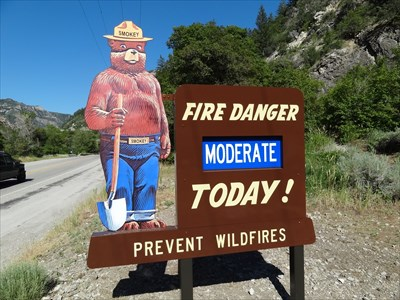
The Smokey Bear signs welcome you to another California town. 

I decided to research the history of Smokey Bear and the wildfire prevention campaign after a long drive through the redwood curtain of Humboldt county, California. The mountain roads of northern California cut through towering redwood trees, some scarred black by wildfires.

Approaching each little gold rush town buried in the mountains are fire danger signs with the danger level for that day. Next to the signs stands Smokey Bear with his signature hat and shovel. He needs no introductory sign thanks to the effectiveness and length of his campaign that has reached every home on the West Coast and beyond. 

The original Smokey Bear 

Smokey Bears first appearance in print showing how to properly put out a campfire.

The wildfire prevention campaign started a year after the Pearl Harbor attack when a Japanese submarine surfaced near the coast of Southern California and fired shells that exploded on an oil field in close proximity to the Los Padres National Forest. This sparked fear of deadly forest fires and encouraged the U.S. government to take precautionary measures. 

The ad council needed to convey a consistent message to deter carelessness with fire and create a memorable mascot to channel that message.

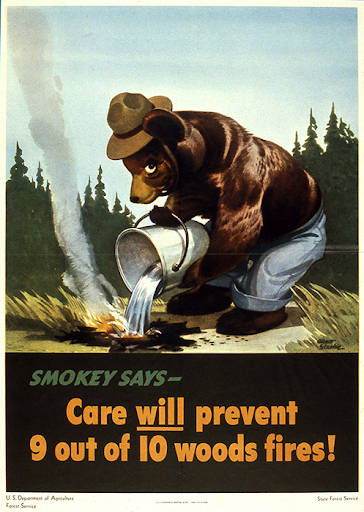
After not being able to use Walt Disney’s Bambi for more than one poster advertisement, the U.S. Forest Service, in collaboration with the Ad Council, came up with the first renditions of Smokey Bear with the original message “Care will prevent 9 out of 10 forest fires” based on the statistic that 9 out of 10 forest fires are caused by humans and can, therefore, be prevented with proper education.

Adapting to new forms of advertising 

Since the beginning of the campaign in 1944, Smokey Bear has appeared in many different forms of advertising from stamps to billboards to TV commercials. The success of the campaign can be partially attributed to the use of Smokey Bear as a mascot. Using a brand mascot like Smokey Bear can strengthen brand identity and brand awareness. It is especially effective for such a long-term campaign that has kept the same message while the world around it changes. 

It is very important to keep up the same message with the same mascot throughout the years but the methods of getting that message across need to change in order to keep reaching your audience. Wildfire prevention commercials aired when commercials became the primary form of advertising, now we are in the age of digital advertising. 

Smokey Bear goes digital

In 2019, to celebrate the 75th birthday of Smokey Bear, the Ad Council released a new digital campaign featuring the beloved mascot as a floating emoji head. Instead of only being able to say his signature line “only you can prevent wildfires,” he is given a voice by celebrities including Betty White, Stephen Colbert, Al Roker and Jeff Foxworthy.

These advertisements were run on social media and other digital platforms. This new campaign continues the same message with the same mascot in a new refreshing way that brings life to the timeless campaign.

About the author

Colin Young is a copywriter at Copper Sun Creative. He specializes in writing advertising and branding content. When he is not blogging or working to complete his bachelor’s degree in Marketing he enjoys doing anything outdoors.
35 Proven Formulas for Writing Headlines

October 1, 2020 Posted by Advertising Book Reviews, History of Advertising, Marketing Advice 0 thoughts on “35 Proven Formulas for Writing Headlines”

Throughout the relatively brief history of advertising and even today, people believe that there is no scientific basis for advertising decisions. Despite the millions of dollars being thrown at advertisers, people often believe that the effectiveness of the advertiser is solely based on their creativity and cleverness.

Although creativity and cleverness can be good assets for an advertiser, your advertisement cannot be proven effective unless it is tested against other advertisements or is based on formulas derived from previous tests.

Because it is often time-consuming and expensive to test ads, this list gives formulas that have already been proven to either spark curiosity, self-interest or other responses that lead people to want to learn more.

Where do these formulas come from?

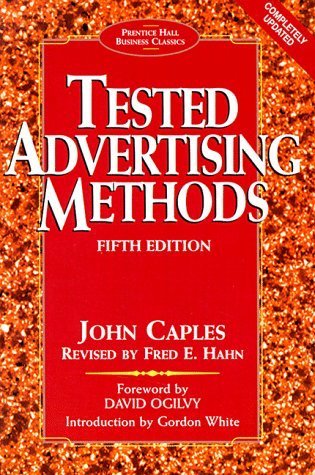
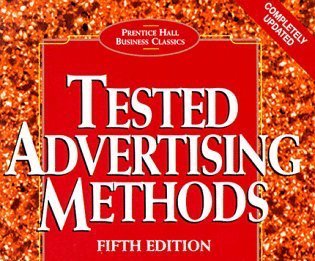
As a newcomer to marketing and advertising, I can’t say that I’ve tested these formulas myself and proven their effectiveness in headlines. These formulas were tested and practiced by the renowned copywriter John Caples and sourced directly from his book, Tested Advertising Methods, which goes in-depth on a wide range of copywriting strategies. 

These keywords are just as effective as they were in 1932 when Caples published his book. If you don’t believe me, keep a copy of this list on your computer and compare it with all the headlines that entice you to click on them or keep reading. 

35 effective headline keywords

Begin your headline with the words:

  1. “How To”
  2. “How”
  3.  “Why”
  4. “Which”
  5. “Who Else”
  6. “Wanted”
  7. “This”
  8. “Because”
  9. “If”
  10. “Advice”
  11. New
  12. Now
  13. At last

More techniques

  1. Use a Testimonial Headline
  2. Offer the Reader a Test (Can Your Kitchen Pass the Guest Test?)
  3. Offer Information in Value
  4. Tell a Story
  5. Warn the Reader to Delay Buying “Don’t buy a new dishwasher until you’ve considered Bosch”
  6. Let the Advertiser Speak Directly to the Reader (Write the entire ad in the first person and speak directly to the reader)
  7. Address Your Headline to Specific Person or Group (Women over 50…”
  8. Have Your Headline Ask a Question (Do you have trouble sleeping at night?)
  9. Offer Benefits Through Facts and Figures
  10. Begin Your Headline with the Word “Introducing”
  11. Begin Your Headline with the Word “Announcing”
  12. Use Words that Have an Announcement Quality (Finally, Presenting, Just Released, etc)
  13. Put a Date Into Your Headline (On February 17 you’ll change your life)
  14. Write Your Headline In News Style (New hand soap takes the midwest by storm”
  15. Feature the Price in Your Headline
  16. Feature Reduced Price
  17. Feature a Special Merchandising Offer
  18. Feature an Easy Payment Plan
  19. Feature a Free Offer
  20. Use a One Word Headline (Fraud)
  21. Use a Two Word Headline (Stop Fraud)
  22. Use a Three Word Headline (Stop Fraud Cold)

Tested formulas remain effective

Caples describes advertising formulas as selling ideas that have worked again and again in the past and can be expected to continue to get results in the future. 

These formulas and the results they have been proven to bring are based in human nature. Even if they were originally tested as newspaper headlines they will still work as article headlines on a website. 

Applying these formulas in practice

Caples clarifies that these formulas are not as concrete as mathematical formulas. They can work for your specific headline or they could not and they could also be reworked and modified to fit your headline. 

These also aren’t the only formulas for writing headlines. New formulas are being invented constantly and if you have the resources and time you can come up with new and effective formulas yourself. 

Lastly, Caples points out that these formulas are not meant to hamper your creative thinking, but rather to guide your thinking into profitable channels. They are not meant to be used as a crutch but as a springboard.

About the author

Colin Young is a copywriter at Copper Sun Creative. He specializes in writing advertising and branding content. When he is not blogging or working to complete his bachelor’s degree in Marketing he enjoys doing anything outdoors.