Posts by carolinemprevite

Made in France: How Le Creuset Built (and Maintains) Its Brand

April 14, 2021 Posted by History of Advertising 0 thoughts on “Made in France: How Le Creuset Built (and Maintains) Its Brand”

As an avid cook who is obsessed with thoroughly researching before any purchase, I’ve seen advertising for countless cookware brands. Whether scrolling through social media or watching commercials on TV, I’ve found it interesting how different brands position themselves to stand out while selling relatively similar products. For example, it’s fascinating to see the way different companies find their niche while advertising one of the most basic and beloved cookware products: the cast iron pan. 

In a world where “Made in…” is stamped on every product and treated as a ubiquitous measure of quality, the French cast iron cookware company Le Creuset has built its brand in the English-speaking world through strategic advertising fundamentals. Through the years, Le Creuset has combined its promise of quality with the unique niche of producing cookware in one of the most celebrated food cultures in the world to create a brand image that’s lasted decades. 

#1. The promise of quality

As one of the more expensive cast iron brands, Le Creuset backs up the price with a guarantee. In his book On Advertising, David Ogilvy writes that “the headlines that work best are those that promise the reader a benefit.” Throughout decades of advertising, Le Creuset has promised customers that their products are durable and will maintain their quality and colorful finish throughout literal lifetimes. 

Naturally, consumers are drawn to the guarantee that, even if they have to spend more for Le Creuset’s product, they won’t have to ever repurchase or replace it. This method is effective in differentiating Le Creuset from newer brands or those with a rotating product lineup. 

Figure 1. Le Creuset promises this dutch oven will outlive its owner. 

#2. The seal of approval 

While Le Creuset consistently advertises the durability and longevity of their product, consumers don’t have to take their word for it. By enlisting industry experts, they’re able to bring in a third party’s seal of approval—and a trusted one at that. 

Figure 2: Professional chefs are the best judges of cookware.

Ogilvy advises that “if you use a testimonial in your copy, you make it more credible.” As he further explains, “testimonials from experts can be persuasive” compared to, for example, celebrities that consumers might believe the company is paying. He uses the example of consulting an ex-burglar on the quality of a safe. After all, who would be a better judge? Likewise, by sharing positive reviews from experts in the cookware and food preparation industry, Le Creuset adds legitimacy to its claims of quality. 

#3. Centering their niche

While competing with American brands that market themselves on their local, homegrown image and “made in America” stamp of quality, Le Creuset uses its unique position as a French company to build its brand image. Rather than try to replicate imagery and branding that’s most familiar to the American eye, Le Creuset makes owning French cookware part of the product’s appeal. 

Figure 3. This ad plays off of the common association of France and fine cuisine.

By centering their image around their country of origin, Le Creuset forms a niche that other brands are unable to copy. The implication of Le Creuset’s branding is that American cooks have a chance to experience and emulate French cuisine from home.

Figure 4: This ad even uses a French headline that’s easily understandable for English speakers.

#4. Consistent branding through the decades

One of Ogilvy’s suggestions that he reiterates throughout On Advertising is to rely on consistent marketing that’s proven to work. He writes that “if you’re lucky enough to write a good advertisement, repeat it until it stops selling.” Later on, he points out that “you’re advertising to a moving parade” and with more expensive products, or ones intended to be kept for years, customers are likely to make just one purchase, meaning remarketing is less of a consideration. In his words, “the advertisement which sold a refrigerator to couples last year will probably be just as successful with couples who get married this year.”

While advertisements have gotten shorter in the digital age, Le Creseut continues to rely on their timeless positioning for newer audiences in every decade. Just as the orange dutch oven serves as their mascot across countless ads, the guarantees that they make to their audience remain central to their branding even today. In fact, their contemporary ads even position their product as the antithesis of today’s cookware scene, claiming to be a “rare, enduring thing” as in the advertisement above. 

Figure 5. Even today, Le Creuset sells endless usage.

Through consistent, timeless branding, Le Creuset has maintained its image as a reliable heritage brand for nearly 100 years. Each of their advertisements is a careful contribution to an overall brand story that has allowed Le Creuset to remain one of the most well-known and trusted cookware companies in the English-speaking world. 

About the author

Caroline Previte is a contributing writer at Copper Sun Creative. She creates blog content related to advertising and branding, and enjoys studying marketing in her free time. 

How to Advertise Travel

March 25, 2021 Posted by Marketing Advice 0 thoughts on “How to Advertise Travel”

With the global tourism industry generating more than $9 trillion every year, a great advertising campaign can be an incredibly lucrative and important investment for both well-loved and up-and-coming destinations. Whether foreign or domestic, travel advertising sells the average person an escape from their mundane everyday life, right at the opportune moment. As a Boston commuter, seeing images of sunny Orlando and San Diego as I shivered at the bus stop or in a stalled MBTA subway car really made me consider searching for last-minute airline tickets day after day.

In his book On Advertising, David Ogilvy breaks down travel advertising based on his experience creating ad campaigns for governments across the world. The following list of guidelines, taken from his chapter “How to Advertise Foreign Travel,” can help you build a strategy to sell travel to the right audiences.

Figure 1: This ad for San Diego ran throughout winter 2019 to 2020 in Boston public transit.

1. Show the places your audience actually wants to see

Ogilvy points out that the image a government agency might want to show to the world is likely not what will bring in tourists, and subsequently, revenue. While the British press wanted to show American tourists that they were a “progressive, industrial society,” Americans were far more interested in historical sites like Buckingham Palace. By catering to the intended audience, Ogilvy’s ads helped move Britain from the fifth most popular European destination for American tourists to the first.

The same principle applies to the San Diego Tourism Authority ad shown above. If San Diego were to advertise, for example, a vibrant art scene, that may not be particularly noteworthy for many commuters in cold Boston or New York City. On the other hand, showing a sunset over a beach and advertising San Diego as an escape from our seemingly endless winter is much more effective. After all, it’s what I would want to visit if I were actually there, and I was reminded of that every day in the subway. 

2. Respond to travelers’ concerns

While most travel advertising should work towards creating a long-term image for a 

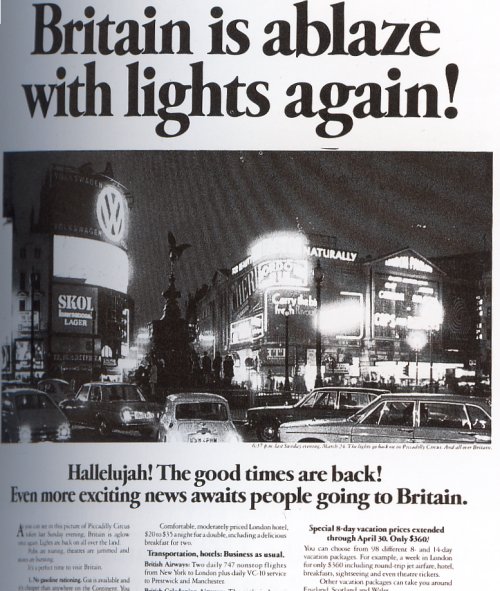
destination, it can also be worthwhile to tackle short-term problems that hinder tourism. Ogilvy mentions working for Great Britain during a time in which the country was experiencing large-scale power outages that were reported widely in the United States. When power returned, the U.S. media lost interest and didn’t report on it, leaving American audiences to assume that Britain was still struggling with outages and wouldn’t be the best place to visit. 

In response, Ogilvy used advertisements to announce that power had returned, and that “even more exciting news awaits people going to Britain.” These short-term pieces functioned as news articles and made travelers less anxious about visiting Great Britain.

Figure 2. This news-like ad invites travelers back to Great Britain.

A similar tactic has been used for places like Nebraska, which doesn’t typically appear on anyone’s bucket list. Each ad in their “Honestly, It’s Not for Everyone” campaign counters common beliefs about the state—for example, ”There’s nothing to do here”—with images of landscapes and activities that travelers can enjoy in Nebraska. The headlines themselves came from recent polls amongst people from neighboring states, who shared their reasons for not visiting Nebraska. By facing these misconceptions head-on, the state can directly appeal to potential tourists and mitigate their concerns.

Figure 3. This ad challenges readers’ perceptions of Nebraska and invites them to explore for themselves.

3. Highlight something unique to your destination

One of the best ways to attract tourists is to promise them something they can’t find anywhere else, and certainly not in their own area. Whether you’re advertising to someone in the neighboring state or halfway across the world, it’s important to focus on your destination’s most unique features. As Ogilvy states, “People don’t go half the way around the world to see things they can equally well see at home.”

Figure 4. Delaware brands itself as a destination for tax-free shopping. It’s definitely unique!

There’s a reason why most advertisements for Cairo feature the pyramids and most advertisements for Paris show off the Eiffel Tower. Tourists want to see the things they’ve seen on television or online, not what they can find in their own city. In Ogilvy’s words, “If you want to persuade the Swiss to visit the United States, don’t advertise ski resorts.” 

4. Target the tourists you want to attract

Travel advertising should not only sell a destination, but it should also sell it to the correct audience. In his book, Ogilvy points to ad campaigns for Bermuda that feature a young American couple to appeal to that same demographic. Choosing to feature a couple over, for example, crowds of beachgoers or families, helped shape Bermuda’s image into that of a romantic getaway rather than a spring break trip. 


Similarly, in the ad campaigns leading up to two major worldwide events, the 2014 FIFA World Cup and the 2016 Summer Olympics, Brazil targeted young people by heavily featuring them enjoying attractions across the country. This helped sell Brazil to young, adventurous people worldwide, without necessarily focusing on the sports events themselves.

5. Educate your audience about your destination, with specifics

Whether the destination itself is unknown or if it’s simply known for the wrong thing, 

educational ads can help raise awareness and spark interest in a place. Taking the tactics he used to advertise Singapore decades ago, Ogilvy advises to “give the reader a lot of specific information” to build familiarity. Your advertisement should convince someone that a place they’ve never heard of has been waiting for them this whole time. Ogilvy’s “Singapore is Fantastic” campaign even taught the reader about religions and clothing styles from the region. 


In the age of the internet, there may not be the same need for a Wikipedia-article level of detail in an advertisement, but using a similar tactic can help keep your destination on your audience’s mind. For example, Mexico’s ad campaign, “The Place You Thought You Knew,” introduces the reader to lesser-known areas of Mexico that may not receive as much tourism, and contains a call to action for the reader to learn more about these sites.

Figure 5. Mexico introduces readers to new sites to visit in the country.

For the average person, traveling is a huge expense of both time and money. Travel advertisements should convince your audience that a trip to your location will be an exciting adventure that they could never experience in their own city or country. Using Ogilvy’s advice and examples, you can build an advertisement that keeps your destination on the map and on your reader’s mind.

About the author

Caroline Previte is a contributing writer at Copper Sun Creative. She creates blog content related to advertising and branding, and enjoys studying marketing in her free time.