Posts by colinyoung445

How to Make TV Commercials that Sell: 16 Tips from David Ogilvy

October 2, 2020 Posted by Marketing Advice 0 thoughts on “How to Make TV Commercials that Sell: 16 Tips from David Ogilvy”

I used to see commercials and wonder, “What are they trying to sell me?” Or remember a funny scene from a commercial and ask, “”What company was that?”
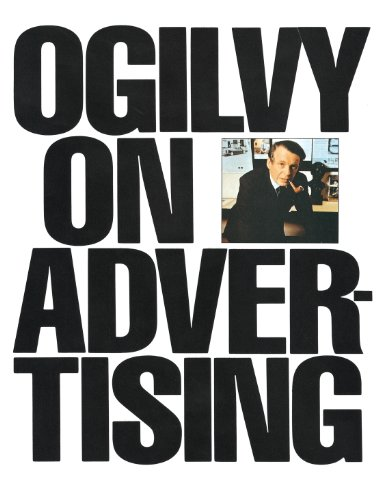
As a copywriting intern at Copper Sun Creative, I have been studying the strategies behind making effective TV commercials. I have been reading books by the advertising greats, including My Life in Advertising and Scientific Advertising by Claude Hopkins, as well as Ogilvy on Advertising by David Ogilvy. Both Ogilvy and Hopkins view advertising as a science and break down the strategies for how to effectively sell to consumers. 

I can now watch commercials and know what strategies a company neglected to use that made the commercial forgettable and why a funny scene was fitting for a comedy skit but not for remembering the brand name. Or notice the techniques used that made a commercial effective and categorize what type of commercial it is. 

Print this list and keep it handy

The list below of types of commercials and tips to create a commercial that sells is straight from David Ogilvy’s book Ogilvy on Advertising. Instead of trying to guess what was going through the minds of the advertisers, the next time you see a commercial that excites your interest in a product or a brand, print out this list and use it to analyze each and every aspect of the commercial. Keep it on your coffee table next to the stack of magazines or keep it in a google doc to bring up on your phone. 

10 types of commercials that change people’s brand preferences 

  1. Humor: Humor is acceptable in commercials..but “very few writers can write funny commercials which are funny. Unless you are one of the few, don’t try.”
  2. Slice of life: A semi-realistic scenario plays out where one person argues with another about the merits of a product and in the end, the doubter is converted. An example of this is Blue Buffalos’ dog food commercials
  3. Testimonials: The most effective are when a loyal customer is using a product and doesn’t know they are being filmed and someone comes up and questions the product and they defend it with conviction. An alternative form of an effective testimonial is the Pepsi challenge.
  4. Demonstrations: These show how well your product works. This works better if you don’t mention competing brands.
  5. Problem/solution: You show the viewer a familiar problem and show how your product can solve it. Snickers uses this in its You’re Not You When You’re Hungry commercials.
  6. Talking heads: A pitch person telling of the virtues of a product. This is used by Old Spice in its The Man Your Man Could Smell Like commercials.
  7. Characters: A character is used to sell a product over a number of years, but the character must be relevant to the product. They become a living symbol of the product. Smokey Bear comes to mind.
  8. Reasons why: Commercials give a reason why the customer should buy the product. 
  9. News: Old products can create news by advertising a new way to use it 

Example: Using baking soda to make your refrigerator smell sweet. 

  1. Emotion: Emotion can be just as effective as rational appeal especially when there is nothing unique to say about your product. You need to be able to justify emotional appeals.

16 tips for creating effective commercials 

  1. Brand identification: Ways to get viewers to remember your brand not just your commercial.
  1. Use the name within the first 10 seconds. 
  2. Play games with the name (example, spell it out).
  3. When you advertise a new product you have to teach people its name.
  1. Show the package 
  2. Food in motion: Example: Milk pouring into cereal 
  3. Close-ups: Good when the product is the hero of the commercial 
  4. Open with fire: You only have 30 seconds so grab their attention in the first frame. When you advertise fire-extinguishers, open with the fire. 
  5. When you have nothing to say, sing it: Jingles can be successful but not at changing brand preferences 
  6. Sound effects: Example: Sausages sizzling in a frying pan 
  7. Voice over or on-camera?: Research shows it is more effective to have actors on camera 
  8. Supers: it pays to reinforce your promise by setting it in type and superimposing it on your video 
  9. Avoid using banality: If you want the viewer to pay attention, show them something they’ve never seen before
  10. Changes of scene: Using a lot of short scenes is not profitable
  11. Mnemonics: (a visual device repeated over a long period of time) — It can increase brand identification and remind people of your promise
  12. Show the product in use
  13. Anything is possible on TV: CGI and special effects can make anything possible 
  14. Miscomprehension: many commercials are not understood, make them crystal clear 

The great scandal: Commercials are very expensive — art directors make them very expensive by not going for cheaper alternatives

About the author

Colin Young is a copywriter at Copper Sun Creative. He specializes in writing advertising and branding content. When he is not blogging or working to complete his bachelor’s degree in Marketing he enjoys doing anything outdoors.
The Smokey Bear Wildfire Prevention Campaign

October 2, 2020 Posted by History of Advertising 0 thoughts on “The Smokey Bear Wildfire Prevention Campaign”

In the weeks prior to the start of World War II, the Ad Council was formed. The Ad Council is an organization that brings together the advertising industry to create advertisements for social good. Going on 76 years, the wildfire prevention campaign, known best for its mascot Smokey Bear and his slogan “Only you can prevent wildfires” is the organization’s longest running and most notable campaign. 

A Smokey Bear on every mountain road 

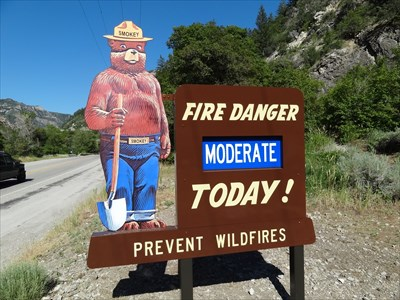
The Smokey Bear signs welcome you to another California town. 

I decided to research the history of Smokey Bear and the wildfire prevention campaign after a long drive through the redwood curtain of Humboldt county, California. The mountain roads of northern California cut through towering redwood trees, some scarred black by wildfires.

Approaching each little gold rush town buried in the mountains are fire danger signs with the danger level for that day. Next to the signs stands Smokey Bear with his signature hat and shovel. He needs no introductory sign thanks to the effectiveness and length of his campaign that has reached every home on the West Coast and beyond. 

The original Smokey Bear 

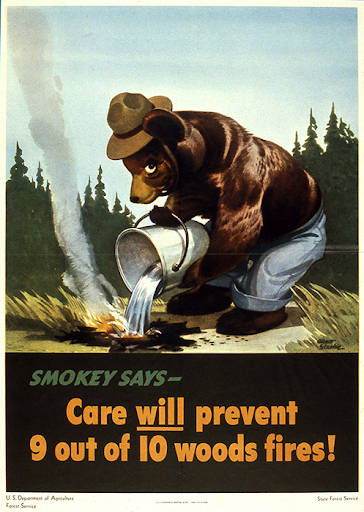
Smokey Bears first appearance in print showing how to properly put out a campfire.

The wildfire prevention campaign started a year after the Pearl Harbor attack when a Japanese submarine surfaced near the coast of Southern California and fired shells that exploded on an oil field in close proximity to the Los Padres National Forest. This sparked fear of deadly forest fires and encouraged the U.S. government to take precautionary measures. 

The ad council needed to convey a consistent message to deter carelessness with fire and create a memorable mascot to channel that message.

After not being able to use Walt Disney’s Bambi for more than one poster advertisement, the U.S. Forest Service, in collaboration with the Ad Council, came up with the first renditions of Smokey Bear with the original message “Care will prevent 9 out of 10 forest fires” based on the statistic that 9 out of 10 forest fires are caused by humans and can, therefore, be prevented with proper education.

Adapting to new forms of advertising 

Since the beginning of the campaign in 1944, Smokey Bear has appeared in many different forms of advertising from stamps to billboards to TV commercials. The success of the campaign can be partially attributed to the use of Smokey Bear as a mascot. Using a brand mascot like Smokey Bear can strengthen brand identity and brand awareness. It is especially effective for such a long-term campaign that has kept the same message while the world around it changes. 

It is very important to keep up the same message with the same mascot throughout the years but the methods of getting that message across need to change in order to keep reaching your audience. Wildfire prevention commercials aired when commercials became the primary form of advertising, now we are in the age of digital advertising. 

Smokey Bear goes digital

In 2019, to celebrate the 75th birthday of Smokey Bear, the Ad Council released a new digital campaign featuring the beloved mascot as a floating emoji head. Instead of only being able to say his signature line “only you can prevent wildfires,” he is given a voice by celebrities including Betty White, Stephen Colbert, Al Roker and Jeff Foxworthy.

These advertisements were run on social media and other digital platforms. This new campaign continues the same message with the same mascot in a new refreshing way that brings life to the timeless campaign.

About the author

Colin Young is a copywriter at Copper Sun Creative. He specializes in writing advertising and branding content. When he is not blogging or working to complete his bachelor’s degree in Marketing he enjoys doing anything outdoors.
35 Proven Formulas for Writing Headlines

October 1, 2020 Posted by Advertising Book Reviews, History of Advertising, Marketing Advice 0 thoughts on “35 Proven Formulas for Writing Headlines”

Throughout the relatively brief history of advertising and even today, people believe that there is no scientific basis for advertising decisions. Despite the millions of dollars being thrown at advertisers, people often believe that the effectiveness of the advertiser is solely based on their creativity and cleverness.

Although creativity and cleverness can be good assets for an advertiser, your advertisement cannot be proven effective unless it is tested against other advertisements or is based on formulas derived from previous tests.

Because it is often time-consuming and expensive to test ads, this list gives formulas that have already been proven to either spark curiosity, self-interest or other responses that lead people to want to learn more.

Where do these formulas come from?

As a newcomer to marketing and advertising, I can’t say that I’ve tested these formulas myself and proven their effectiveness in headlines. These formulas were tested and practiced by the renowned copywriter John Caples and sourced directly from his book, Tested Advertising Methods, which goes in-depth on a wide range of copywriting strategies. 

These keywords are just as effective as they were in 1932 when Caples published his book. If you don’t believe me, keep a copy of this list on your computer and compare it with all the headlines that entice you to click on them or keep reading. 

35 effective headline keywords

Begin your headline with the words:

  1. “How To”
  2. “How”
  3.  “Why”
  4. “Which”
  5. “Who Else”
  6. “Wanted”
  7. “This”
  8. “Because”
  9. “If”
  10. “Advice”
  11. New
  12. Now
  13. At last

More techniques

  1. Use a Testimonial Headline
  2. Offer the Reader a Test (Can Your Kitchen Pass the Guest Test?)
  3. Offer Information in Value
  4. Tell a Story
  5. Warn the Reader to Delay Buying “Don’t buy a new dishwasher until you’ve considered Bosch”
  6. Let the Advertiser Speak Directly to the Reader (Write the entire ad in the first person and speak directly to the reader)
  7. Address Your Headline to Specific Person or Group (Women over 50…”
  8. Have Your Headline Ask a Question (Do you have trouble sleeping at night?)
  9. Offer Benefits Through Facts and Figures
  10. Begin Your Headline with the Word “Introducing”
  11. Begin Your Headline with the Word “Announcing”
  12. Use Words that Have an Announcement Quality (Finally, Presenting, Just Released, etc)
  13. Put a Date Into Your Headline (On February 17 you’ll change your life)
  14. Write Your Headline In News Style (New hand soap takes the midwest by storm”
  15. Feature the Price in Your Headline
  16. Feature Reduced Price
  17. Feature a Special Merchandising Offer
  18. Feature an Easy Payment Plan
  19. Feature a Free Offer
  20. Use a One Word Headline (Fraud)
  21. Use a Two Word Headline (Stop Fraud)
  22. Use a Three Word Headline (Stop Fraud Cold)

Tested formulas remain effective

Caples describes advertising formulas as selling ideas that have worked again and again in the past and can be expected to continue to get results in the future. 

These formulas and the results they have been proven to bring are based in human nature. Even if they were originally tested as newspaper headlines they will still work as article headlines on a website. 

Applying these formulas in practice

Caples clarifies that these formulas are not as concrete as mathematical formulas. They can work for your specific headline or they could not and they could also be reworked and modified to fit your headline. 

These also aren’t the only formulas for writing headlines. New formulas are being invented constantly and if you have the resources and time you can come up with new and effective formulas yourself. 

Lastly, Caples points out that these formulas are not meant to hamper your creative thinking, but rather to guide your thinking into profitable channels. They are not meant to be used as a crutch but as a springboard.

About the author

Colin Young is a copywriter at Copper Sun Creative. He specializes in writing advertising and branding content. When he is not blogging or working to complete his bachelor’s degree in Marketing he enjoys doing anything outdoors.
Four Reasons Why the Pepsi Challenge Was an Effective Campaign

July 22, 2020 Posted by History of Advertising 0 thoughts on “Four Reasons Why the Pepsi Challenge Was an Effective Campaign”

Pepsi vs Coke: How it all started

The existence of product substitutes inevitably leads to competition. It’s one of the driving forces of commerce. But every once in awhile a competition arises that is so big it turns in to an all-out war. This is what happened when Pepsi came out with its unforgettable Pepsi challenge campaign in the 1970s. 

In a series of advertisements, Pepsi showed real customers choosing Pepsi over Coca-Cola in blind taste tests. These advertisements threatened Coke’s status as the king of Cola and helped level the playing field for the two companies. 

In this blog, I will analyze one of Pepsi’s advertisements and explain why it was so effective at disrupting the reign of Coke and fueling the Cola war fire. 

Why this advertisement works

1. Celebrity endorser 

For you young readers out there like me you probably didn’t notice that the narrator in the commercial was actually a popular celebrity at the time. Gabe Kaplan is an American comedian best known for his role on the sitcom Welcome Back, Kotter, which also starred John Travolta. Kaplan’s presence in this commercial was a strategic decision for Pepsi. 

There has been research and criticism about celebrity endorsers for products saying that people know they are being paid off so it doesn’t seem truthful. In this advertisement though, Kaplan is not just saying he likes the product so you should buy it, he is walking you through the scenes of real people like you vouching for the superior taste of Pepsi.  

2. The use of humor 

On top of Gabe Kaplan lending a familiar face to the commercial to make it more memorable, he also adds the humor. The attention of the viewers will not be held by a narrator who walks them through the commercial in a monotonous way. Kaplan’s humorous and playful attitude holds the attention of the viewer while the commercial changes their perceptions of Pepsi.

Humor in advertisements has also been shown to associate positive emotions elicited from the advertisement with the product and make long-lasting impressions on the viewers. 

3. Testimonials from real people

Testimonials from consumers are a great advertising strategy. It is an effective way for a brand to show the benefits of a product that doesn’t give the viewer the impression that an actor is being paid to read a script. 

The father of modern advertising, Claude Hopkins, was adamant about the redirecting the focus of advertising back to the “common people.” With an everyday consumer good like cola, you don’t want to advertise to a small percentage of wealthy people, you want to advertise to the millions of regular people who will need to decide between Coke or Pepsi the next time they go to the corner store. 

Pepsi’s use of volunteer firefighters, regular old community members, as their experiment group, represents the millions of viewers watching the commercial. 

4. Take the Pepsi challenge 

The slogan that caps off the commercial is “take the Pepsi challenge, let your taste decide.” 

I grew up in the age of the ice bucket challenge and the countless tik tok promotional challenges circulating today, but I did not hear about the Pepsi challenge until I started my research. 

I decided to call up my mom and ask her if she recalls the Pepsi challenge from her youth in the ’80s. She recounted memories of doing the challenge at birthday parties and with friend groups. And she went on to recall the intensity of the great American cola wars that followed. 

Like a viral social media challenge today, the Pepsi challenge raised brand awareness for Pepsi on an unprecedented level and convinced consumers to try the product themselves instead of taking the companies word for it. 

Final thoughts

The Pepsi challenge commercials were an effective way of pushing Pepsi into the spotlight and giving Coke a well-needed challenge. The blending of traditional advertising strategies such as using a celebrity, using tasteful humor, and including real people with the powerful and hard-to-achieve use of a viral challenge made Pepsi the household name it is today. 

About the author

Colin Young is a copywriter at Copper Sun Creative. He specializes in writing advertising and branding content. When he is not blogging or working to complete his bachelor’s degree in Marketing he enjoys doing anything outdoors.
Snickers vs. Oldspice: Conveying Benefit in Commercials

July 11, 2020 Posted by Marketing Advice 0 thoughts on “Snickers vs. Oldspice: Conveying Benefit in Commercials”

Think about why you buy things. You want to get some benefit from the product, right? Buying a certain product makes your life easier or better in some way. Companies are well aware of this desire to gain something from products. Snickers and Old Spice shaped these two entertaining and memorable commercials around this concept. 

Snickers: Super Bowl XLIV 44 2010 commercial

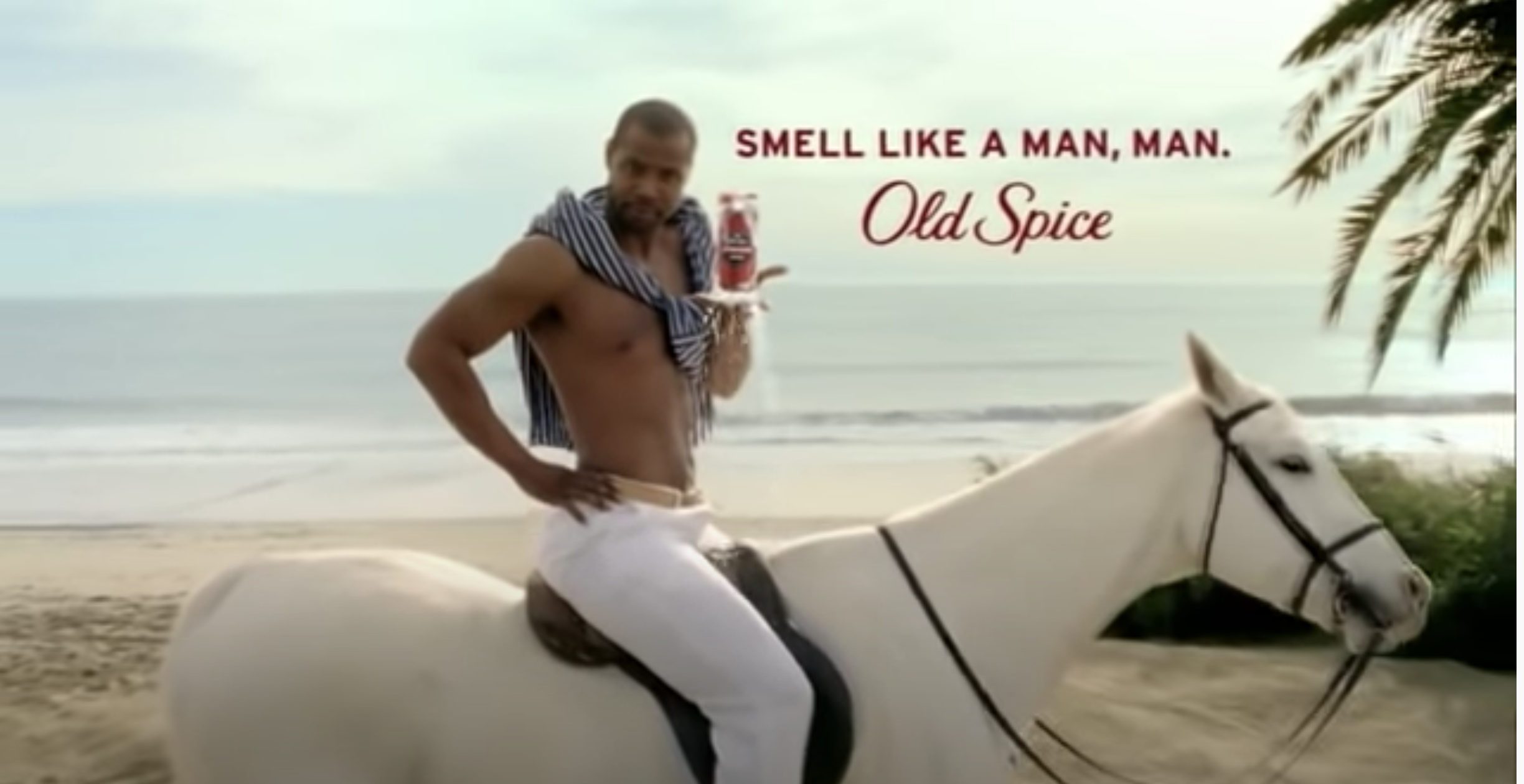
Old Spice: The Man Your Man Could Smell Like commercial 

Both commercials, in their own ways, show how their product can benefit you. If you focus on the message being communicated behind the theatrical displays, they are simply saying, this is what our product will do for you, buy it. 

How Snickers conveys benefit 

For Snickers, their tagline is “You’re not you when you’re hungry.” This brilliant strategy takes a Snickers bar, which is really no different from any other unhealthy candy bar, and shows its benefit to you beyond satisfying a craving. They show how you as a person change when you’re hungry and Snickers can reverse this and make you better. They took a simple candy bar and gave it the benefits of an energy bar. The playfulness and humor in this ad, along with the attention-grabbing and surprising scenes of older actors being tackled into a muddy football field make the message very memorable.  

How Old Spice conveys benefit 

For Old Spice, their commercial was no less fun and entertaining. In contrast to the few sudden attention-grabbing moments in the Snickers commercial, the whole commercial is fast and interactive. Your attention is held by chaotic visuals and the narrator not giving you a chance to look away unless he tells you to. The narrator guides you through the fantastical world of the perfect Old Spice user. 

At the end of the commercial, the narrator slips in the tagline “Anything is possible when your man smells like Old Spice and not a lady.” The commercial is implying that if you use old spice,  you can be like the perfect man in the commercial. The possibilities are endless when you try this product. 

Which commercial is more effective?

The more effective of the two commercials is subjective. When talking about entertainment value or overall effectiveness of the commercials, opinions differ. When focusing on how well the companies communicated the benefit of their products to the consumer, I believe that Snickers takes the cake.

What challenge did both companies face?

Both companies had the task of taking products that offer no real exciting or different benefit that stands out from their competitors. They were challenged with taking relatively unexciting products and making them beneficial to you. What makes the Snickers commercial better is that the benefit they offer is attainable and realistic. 

Why Snickers conveys their benefit better 

Snickers doesn’t need to claim that you will be the most attractive perfect person by using their product. They make a claim that has truth to it even though it was communicated through an impossible and exaggerated story. Old Spice, in contrast, had a great and entertaining commercial that hooked you in for the whole thirty seconds but their claim was too grand. 

You may have skipped breakfast and you grab a Snickers bar while shopping because you remembered that “You’re not you when you’re hungry,” but when you’re eye catches the Old Spice bottle, you may choose it over other brands because you remember how entertaining the commercial was, but you will not grab it in hopes that you can become the perfect man by buying it. 


About the author

Colin Young is a copywriter at Copper Sun Creative. He specializes in writing advertising and branding content. When he is not blogging or working to complete his bachelor’s degree in Marketing he enjoys doing anything outdoors.
What’s Behind the Advertisement: Then and Now

July 11, 2020 Posted by History of Advertising, Marketing Advice 0 thoughts on “What’s Behind the Advertisement: Then and Now”

How consumers behave hasn’t changed much over the years, but the methods of studying it and its prominence in advertising have. As advertising has evolved, so has its relationship with consumer behavior research. In this blog, I will examine the early history of using consumer behavior to advertise and how it is used today. 

The early history of consumer behavior in advertising 

Claude C. Hopkins is known as the father of modern advertising. During his working life, he brought advertising into a new age using scientific methods of selling. Hopkins believed that the sole purpose of advertising was to sell products and using data from actual sales was the only way to get the job done. 

Figure 1. Hopkins figured out through research that people didn’t want to hear about protecting their teeth, they wanted to hear that a product will make their teeth white and beautiful.

Hopkins discovered consumer behavior trends through testing his advertisements himself. He would test different variations of advertisements and run whichever one got the most attention from consumers. He saved many companies millions of dollars by using data to guide advertising decisions instead of guessing which advertisement would work. 

Creativity is not everything 

Many advertisers since Hopkins and even today still rely on their creative instincts to guide their decisions. David Ogilvy, a successor to Hopkins as one of the most influential persons in advertising, was a fervent critic of this baseless view of advertising.

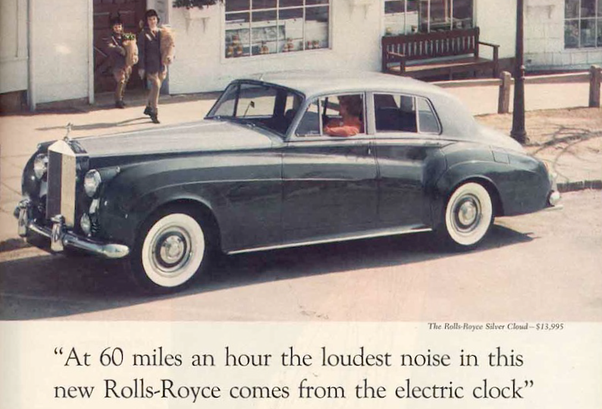
An Ogilvy advertisement is easily recognizable by its simple and many times replicated format. As you can see in the example below, his advertisement layouts were an image, a headline and body copy with black text and white background, from top to bottom. 

Figure 2. Ogilvy crafted this headline around his knowledge that wealthy people wanted peace and quiet while driving.

Ogilvy did this because he knew, through consumer behavior research and experience, that 10% more people will read the headline when it is below the image, and that it is easier for people to read text when it is black with a white background.  

Keep in mind that he did not lack creativity in his advertisements, far from it in fact, but he did not let it guide his work. He figured out what consumers would react to, and only then used a creative touch to make his advertisements stand out. 

Consumer behavior in advertising today 

The fields of consumer behavior and psychology have grown enormously since Ogilvy’s time. As psychology has become more credible as a science, it has been used increasingly in advertising. 

An example of a recent research study on consumer behavior is a study done by Zhang and Bloemer in 2008 on the impact of value congruence on consumer service and brand relationships. This study shows that when consumers share similar values with a brand it leads to more satisfaction, trust and loyalty to that brand.

An example of research like this being used in a campaign is the support of the Black Lives Matter movement by many corporations. Many companies are aligning their brand values with this movement and, in turn, are creating a trusting relationship with consumers who share similar values. 

Figure 3. Ben and Jerry’s is aligning their values with progressives and supporters of the Black Lives Matter movement.

My take

In my opinion, modern advertising should be a balance between the testing methods that Hopkins founded and the modern consumer behavior research that advertisers use today. 

I believe that the principles of Hopkins are important to include because even if a study says consumers will act a certain way, there is no guarantee that it will work for every company in every market. For example, Ben and Jerry’s supporting the Black Lives Matter movement works because they have a history of supporting grassroots progressive movements. If the same tactic was used by Amazon, for example, it may come off as insincere. 

Overall, the study of consumer behavior was a driving force in the creation of modern advertising and the progression of advertising today. The importance of knowing how consumers will react to advertisements is just as important as it was in Hopkins times and it should not be overlooked. 


About the author

Colin Young is a copywriter at Copper Sun Creative. He specializes in writing advertising and branding content. When he is not blogging or working to complete his bachelor’s degree in Marketing he enjoys doing anything outdoors.
How ‘The Worst Hostel in the World’ Built Its Bold Brand Image

July 11, 2020 Posted by Marketing Advice 0 thoughts on “How ‘The Worst Hostel in the World’ Built Its Bold Brand Image”
One of Amsterdam’s many pub-filled streets

I stopped by the hostel my sister was staying at. It was a dingy place with prison-like bunk beds. There was a pub in the basement where the green felt of the pool table was stained grey and black from cigarette smoke and ash and the watery beer was served by the pitcher in opaque plastic cups. 

Appealing to customers with the unappealing 

This is the kind of environment that Hans Brinker hostel, the self-proclaimed “Worst Hostel in the World” prides itself for. Hans Brinker is a budget hostel that has nothing special or welcoming to offer, so they focused on what they had. 

They appealed to their target market, partying young people, through clever advertisements glorifying the unsanitary and bare minimum conditions that they offered. 

The worst hostel in the world 

Hans Brinker began positioning its brand this way in the 90s when they were tired of hearing complaints about how poor the conditions of their hostel were. They had nothing special to offer. Nothing that could differentiate them from competing budget hostels in the area. 

They decided that if the customers expected nothing from them, they wouldn’t complain when they got nothing special from their stay. 

From this idea, Hans Brinker Hostel created a series of hilarious advertisements that both mocked traditional hotel advertising and set realistic expectations for their young audience who could relate to the humor and irony of the ads. 

Hans Brinkers most memorable advertisements 

A very crappy advertisement

The very bold and eye-catching image above was put on small flags and placed in piles of dog poop all around the city of Amsterdam. This guerilla advertising tactic executed by Hans Brinkers employees brought media attention from around the world. 

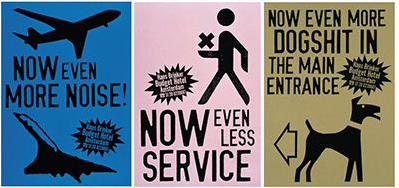
NOW even more clever ads!

Hans Brinker’s series of advertisements mocking old school urgency advertisements

Through these campaigns, Hans Brinkers played off of old school advertising showing urgency. Of course instead of offering outstanding service or pristine rooms they offer the minimum of what is expected or even the most undesirable things associated with hostels. 

The good ole before and after 

One of a series of “before and after” advertisements showing what a night at the Hans Brinker entails

Through many different variations of this advertisement, Hans Brinkers shows their target market, young party-going people, when they check into the hostel and when they check out. This ad shows they want their customers to party and have a good time and quality service and comfort are not to be expected. 

There’s no way this could work, right?

The very unorthodox methods of Hans Brinker Hostel yielded impressive results. Their bookings spiked with the release of advertisements that pointed out what was once viewed as their greatest flaws as a hostel. 

This worked because Hans Brinkers established a consistent brand image with an offer that appealed to their target market. Young students traveling to Amsterdam to party and stay out all night are not looking for a luxury room to relax in. They are looking for the cheapest option that will give them a place to go back to after last call. 

The use of humor and irony in the advertisements also made them relatable for young people who often push back against traditional advertising. 

Hans Brinkers’ brand image didn’t set expectations beyond what they could offer. For this reason, they are still one of the most popular hostels in Amsterdam. 


About the author

Colin Young is a copywriter at Copper Sun Creative. He specializes in writing advertising and branding content. When he is not blogging or working to complete his bachelor’s degree in Marketing he enjoys doing anything outdoors.

What Is Scientific Advertising?

June 18, 2020 Posted by Advertising Book Reviews, History of Advertising 0 thoughts on “What Is Scientific Advertising?”
Inside you’ll find the secrets of advertising from the original master of the craft.

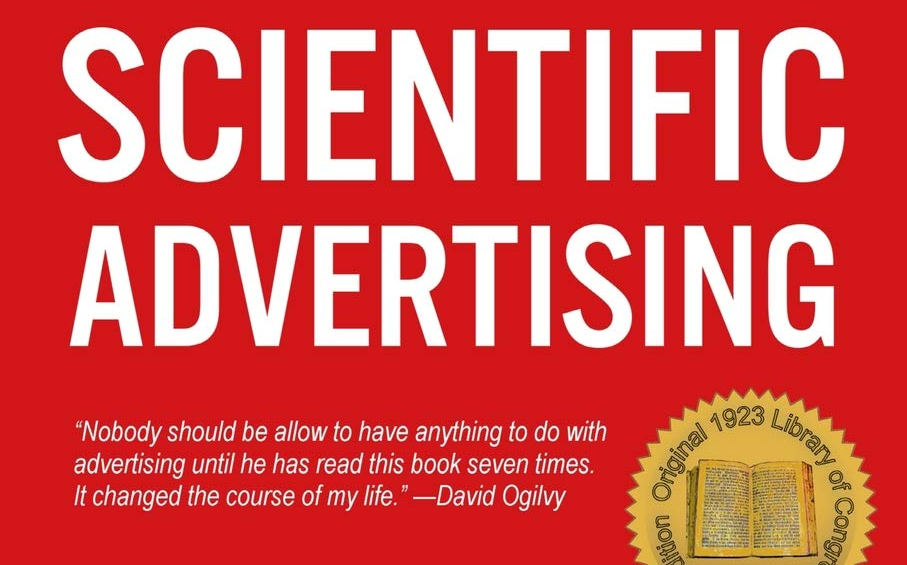
Scientific Advertising was written by the renowned advertiser Claude C Hopkins in 1923. Hopkins is known by many as the father of advertising. Through a lifetime of revolutionary work, Hopkins developed unprecedented strategies to advertise effectively without taking huge financial risks. He lists out his most important strategies for advertising in a scientific and reliable way. In Scientific Advertising Hopkins shares his secrets to advertising success with the world. 

Why read this book?

As the end of my college career is in sight, I am preparing to dive into the workforce. As a marketing major with an interest in advertising and copywriting I am struggling to identify and focus on coursework that will help me excel in my career. 

“The man who wins out and survives does so only because of superior science and strategy.”

– Claude Hopkins 

Marketing literature and college courses will flood you with a lot of information, but it is often difficult to see the bigger picture and use this information in practice. Scientific Advertising helped me set a solid foundation of advertising knowledge to build off of. 

Hopkins neatly organizes the book by chapters that briefly but thoroughly explain each strategy that he feels are essential for effective advertising. This spares you the task of trying to identify what’s important in your marketing textbooks. 

Scientific Advertising is not just important for people starting their careers. No matter where you are in your career in marketing or advertising, this book is a valuable asset. Even if you are an experienced advertiser, it can only help to go back to the main principles that advertising is based on.

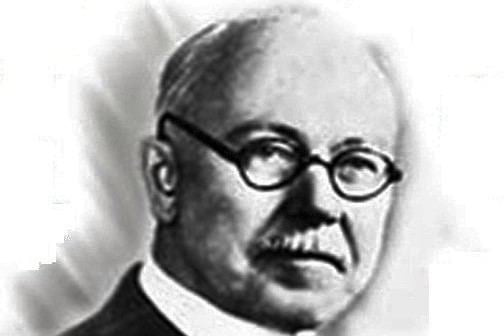
Claude C Hopkins - Alchetron, The Free Social Encyclopedia
The grandfather of Advertising himself, Claude C. Hopkins

What are Hopkins’ strategies, and why should I care about them?

I have praised the advertising strategies in this book enough, it’s about time I tell you what they are.

The book’s twenty-one chapters each focus on a strategy or principle of advertising Hopkins deems essential. He shares short anecdotes about his most successful campaigns and how he discovered which strategies worked and which didn’t. He ties off each chapter by summarizing why each strategy matters. 

Here are three of the strategies I think are the most important. The rest you will have to discover yourself. 

#1. Advertising is data- and results-driven 

The main overarching strategy is using data and results to guide advertising 

When Hopkins first entered the field, advertising was new and mostly based on gut feelings and guesswork. Hopkins revolutionized the field by using testing and data to see which advertisements led to sales and which ones flopped.

This, as he repeatedly states, can save companies millions. By testing advertisements instead of coming up with something clever and running it, you can see how consumers will react. This means you can run a campaign when tests show a positive public response and not run it when consumers were tested and there isn’t much excitement.

#2. The importance of samples 

Hopkins explains how using samples has helped him save companies on the verge of bankruptcy, and how no matter the cost of sampling, it will probably still be the cheapest method of advertising.

Hopkins rules for samplings are as follows: Give samples only to interested people who have heard your story, and create an atmosphere of respect, a desire, and an expectation before giving your sample. 

#3. Advertising is just salesmanship 

Hopkins doesn’t let you forget that the point of advertising is to sell products and services. In his mind, the only difference between advertising and salesmanship is the audience. The audience of a salesperson is one person, the audience of an advertisement is thousands or millions.

Hopkins states that there is one way to answer many advertising questions. That way is to ask yourself “Would this help a salesman sell goods?” and “Would it help me sell them if I met a buyer in person?” 

In conclusion…

I hope this post gives you a good idea of what Claud Hopkins discovered throughout his career, and how it is applicable to advertising today, but I urge you to still read the book yourself. There is no mathematical formula for coming up with a great advertisement, but the contents of the book are close to it. If you are interested in advertising or looking to enhance your advertising skills this is the book for you. 


About the author

Colin Young is a copywriter at Copper Sun Creative. He specializes in writing advertising and branding content. When he is not blogging or working to complete his bachelor’s degree in Marketing he enjoys doing anything outdoors.